
I get this question regularly.
Not surprising, as I constantly emphasize the importance of this knowledge during presentations, lectures, and (practical) training courses to everyone who deals with (farm) animals, both at home and abroad. Because if you know how an animal reacts to its environment, you can move it in a more animal-friendly, safer, and more efficient way. In other words: Low Stress Stockmanship in practice. In a few short posts and in simple human language, I will answer the above question.
Mammals send signals to the brain via the eyes, the "control center" for functioning and survival. In humans and mammals with forward-facing eyes, the nerve pathways that send signals to the brain run more parallel, allowing for better depth perception.
In mammals that have their eyes on the sides of their heads, virtually all nerve pathways that send signals to the brain run crosswise. This optic chiasm ("chiasma opticum") is essential as a crossroads for binocular (two-eyed) vision and is located just above the pituitary gland. This crossing sends visual information from the left visual field to the right hemisphere of the brain, and vice versa.
The amygdala functions as the emotional control center of the brain, with the right amygdala performing more specialized functions compared to the left amygdala.
WHAT IS THE AMYGDALA:
The amygdala is an almond-shaped cluster of nerve cells (the neurons). In this area of the brain, emotions and feelings are processed.
It is THE area that, with excessive stress, autonomously switches to a fight, flight, or freeze mode, a survival strategy of nature. We humans know this as the expression "paralyzed by fear." Prior to the activation of this survival strategy (fight, flight, freeze), and while experiencing a high degree of (chronic) stress, affected people and animals often experience loss of concentration and nervousness.
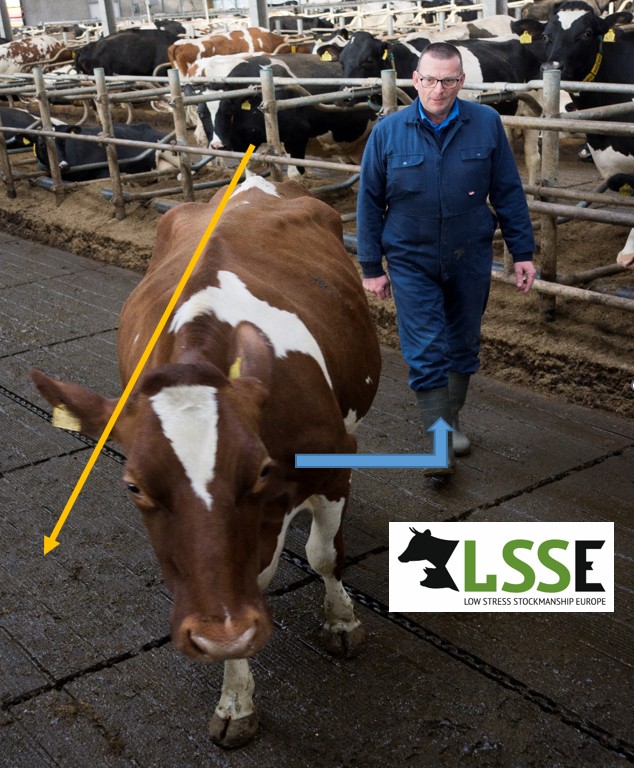
THE FUNCTIONAL CONTEXT IN LIVESTOCK FARMING FOR HUMANS AND ANIMALS:
In the context of livestock farming and animal sciences, the amygdala is essential for understanding how animals experience their environment themselves, and it also explains how they react to stressful situations.
Especially in (agricultural) domestic animals, the amygdala is a "watchdog" of the brain in a state of heightened readiness.
For example, the amygdala uses the hypothalamus to control various physical reactions, such as an increase in heart rate and breathing during herding, treatment, or during transport or handling (the reaction to this is an autonomous function).
Another example is the increased production of the stress hormone Cortisol (as a reaction to an acute threat, it increases alertness, the burning of fats/proteins, and regulates blood pressure).
In a stressful situation (read: a negative emotional arousal such as fear and aggression), the right amygdala often shows higher activity than the left.
Source photos Ronald Rongen